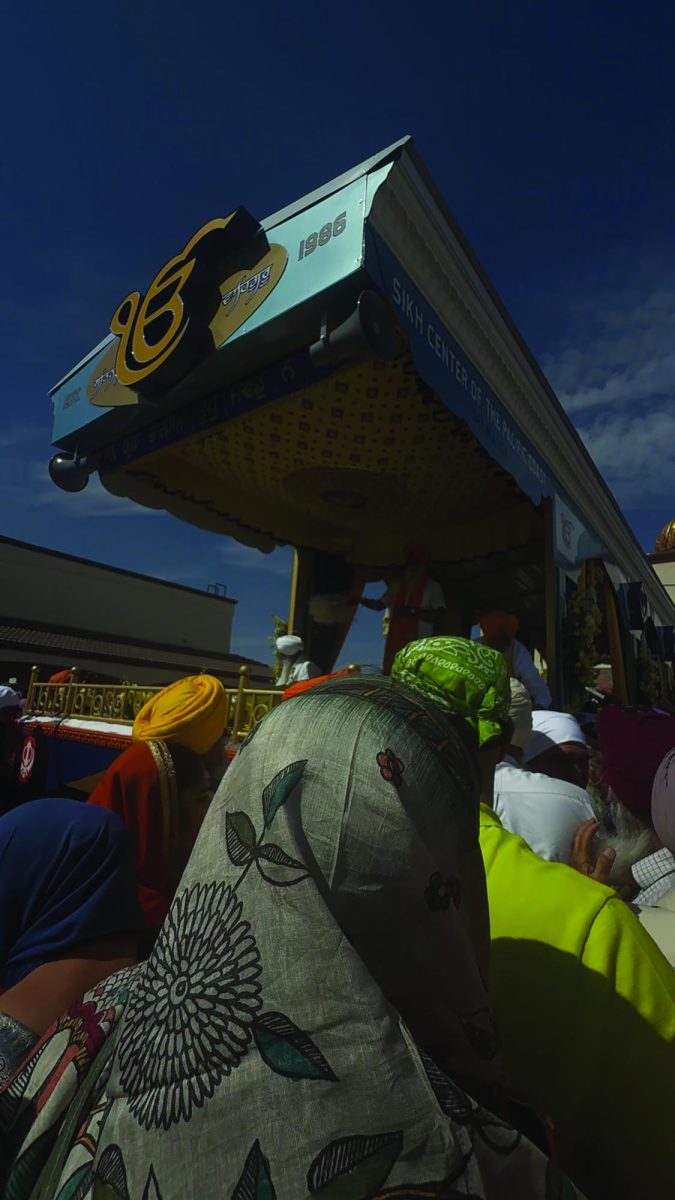
In the second week of April 2026, the Sikh Center of the Pacific Coast opened its gates to welcome both followers of the Sikh faith and individuals offering their selfless service to coordinate the exuberant and multicolored Nagar Kirtan parade that celebrates Vaisakhi. It was a celebration packed with bustling life and attendees containing different backgrounds that came together into a singular unity of fellowship, benevolence, and inclusivity to coordinate this event.
With each vitality, the olfactory sense was activated with delectable flavors sticking to the air as eyes sparkled with the reflection of passing floats that held proof of an everlasting cultural legacy.
This year Selma High’s ROTC and Punjabi club went to volunteer at the yearly celebration of Vaisakhi. Vaisakhi is one of the most important festivals in the Sikh religion, celebrated every year in April to mark both the harvest season in Punjab and a major historical moment in Sikh history. It commemorates the founding of the Khalsa in 1699 by Guru Gobind Singh (The last living spiritual guide), who established a community of committed Sikhs dedicated to equality, courage, and faith. On this day, Sikhs gather at the gurudwara for prayer, Kirtan (hymns) that are sung from the Guru Grath Sahib (the holy scripture), and take part in this procession called the Nagar Kirtan.
“The Nagar Kirtan represents our values of equality, service, and community. It’s not just a celebration, but also a way to share our culture, history, and faith with others,” expressed Ms. Kaur, the Punjabi club teacher at Selma High.
The Nagar Kirtan is the parade that circles Selma High. However, before Punjabi can achieve the procession, the Sikh communities prepare over several days. These days are often beginning with continuous reading of the Guru Grabth Sahib known as Akhand Path.
The Akhand Path is held within the three day festival, accompanied by food, laughter, and remembrance. On the 3rd day, the Nagar Kirtan procession is held, where the Guru Grabth Sahib is respectfully carried at the front while participants sing hymns and walk together through the streets, Members of the Khalsa often perform Gatka, a traditional martial art, and volunteers distribute free food and drinks to those along the route. These services are not only for the Sikh participants, but are for all the come or watch in respect.
“What the parade meant to me was building a closer bond with my community and people,” Lupe Hernandez, a junior at Selma High, stated.
Furthermore, she shares that culture is the idea of getting closer to one’s heritage and beliefs. By teaching future generations about their families’ history, they can avail in shaping the future and ensuring that heirlooms, unwritten rules, language, emblems, tradition, and celebrations towards figures are passed down.
“I enjoyed the overwhelming kindness by the people I met there and I loved how the community provided food for anyone and everyone who came,” senior Jennasi Cortez, a MCJROTC cadet who helped with the event, shared.
The Punjabi club, JROTC, and members of the community all left this celebration feeling connected and inspired, regardless of birthplace or story. It was a moment of equality that clearly emphasized the importance of honoring diversity with great enthusiasm.